
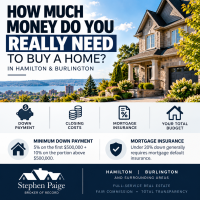
How Much Money Do You Really Need to Buy a Home in Hamilton or Burlington?
One of the biggest mistakes prospective homebuyers make is focusing entirely on the down payment.
You find a home for $700,000, calculate the minimum down payment and assume that’s approximately how much cash you need.
It isn’t.
Buying a home involves the down payment plus closing costs and other expenses, and understanding those numbers before you start looking can prevent an unpleasant surprise after you’ve already found the property you want.
Here’s what buyers in Hamilton, Burlington, Ancaster, Stoney Creek, Waterdown and surrounding areas should understand before beginning their search.
How Much Down Payment Do You Need?
For an owner-occupied home eligible for insured financing, current CMHC rules generally require a minimum down payment of:
5% of the first $500,000 of the purchase price, plus 10% of the portion above $500,000.
Homes priced at $1.5 million or more are not eligible for CMHC mortgage insurance and generally require at least 20% down.
So let’s look at a practical example.
If you purchase a $700,000 home:
5% of the first $500,000 = $25,000
10% of the remaining $200,000 = $20,000
Minimum down payment = $45,000
But that doesn’t mean you should begin shopping for a $700,000 property with exactly $45,000 sitting in your bank account.
What Happens If You Put Less Than 20% Down?
When your down payment is below 20%, your mortgage will generally require mortgage default insurance.
This insurance protects the lender, not the homeowner, if the borrower defaults.
The insurance premium depends partly on the size of the mortgage and down payment and can generally be added to the mortgage rather than paid entirely upfront.
That allows many buyers to purchase without waiting until they’ve accumulated a 20% down payment, but it also increases the overall cost of borrowing.
Don’t Forget About Closing Costs
The down payment isn’t the only money you’ll need.
Ontario buyers can also encounter expenses such as:
- Ontario Land Transfer Tax
- Legal fees and disbursements
- Title insurance
- Home inspection costs
- Property-tax adjustments
- Moving expenses
- Other transaction-specific adjustments or expenses
Ontario imposes land transfer tax when an interest in land is transferred, although qualifying buyers may be eligible for applicable rebates or exemptions.
The exact amount you need at closing therefore depends on the property, purchase price and your individual circumstances.
Your Deposit Is Not an Extra Down Payment
This causes a surprising amount of confusion.
When an offer is accepted, the buyer will normally provide a deposit as part of the transaction.
That deposit is credited toward the purchase price on closing.
For example, if your total down payment will be $100,000 and you’ve already provided a $50,000 deposit, you don’t normally need another $100,000 down payment on closing.
The $50,000 deposit forms part of it.
You would still need the remaining funds required to complete the purchase, along with your closing expenses.
Should You Put 20% Down If You Can?
Not necessarily.
Putting 20% down avoids mortgage default insurance, but that doesn’t automatically make it the right financial decision for every buyer.
You also don’t necessarily want to drain every dollar of savings simply to reach 20%.
Homeownership comes with expenses.
Furnaces break. Roofs eventually need replacement. Appliances fail. Property taxes arrive. Moving costs money.
Having a house and virtually no accessible savings afterward can leave you financially vulnerable.
The better question isn’t simply:
“What’s the biggest down payment I can make?”
It’s:
“How much can I comfortably put down while still maintaining an appropriate financial cushion after closing?”
That’s a conversation worth having with your mortgage professional before deciding on your price range.
Get Pre-Approved Before You Start Looking
This is one of the most important steps I recommend to buyers.
Before we begin booking properties, you should know approximately:
What purchase price you qualify for, what your expected mortgage payment will be, how much cash you’ll need to close, and what price range you’re actually comfortable carrying.
Those aren’t necessarily the same thing.
Being approved for a particular mortgage doesn’t mean you need to spend every dollar the lender is prepared to give you.
A realistic budget makes the home search considerably more productive.
The Bottom Line
Buying a home requires more than simply saving a down payment.
You need to consider your down payment, deposit, closing expenses, mortgage structure and the amount of money you’ll have left after closing.
Get those numbers established before falling in love with a property.
If you’re planning to buy in Hamilton, Burlington, Ancaster, Stoney Creek, Waterdown, Dundas, Grimsby or surrounding areas, I can help you understand the buying process, identify suitable properties and negotiate once the right opportunity comes along.
Stephen Paige, Broker of Record
Full-Service Real Estate. Fair Commission. Total Transparency.
Mortgage qualification and financing requirements vary by borrower and lender. Buyers should confirm their individual financing and closing requirements with their mortgage and legal professionals.

Post a comment